
People of a certain age grew up reading the adventure novels of Hammond Innes, one of his books “The Wreck of the Mary Deare”, published in 1956, describes skulduggery on an offshore reef and its repercussions. Three years later it was made into a film starring Gary Cooper and Charlton Heston. The reef was the Minquiers, Jersey’s largest offshore reef, which lies approximately 12 miles to the south of the island.
As a general rule it is visited far less frequently than the Ecrehous, by members of the local kayaking community, possibly because it is twice as far, meaning that it is either a significant day trip, or requires an overnight stay. In common with the Ecrehous the number of visitors to the reef has increased exponentially in recent years.
Fortunately most sea kayakers will want to visit on Neaps, as the crossing from Jersey is easier, than on Springs. The majority of people, who arrive via other types of craft, want to go on Springs because that is when the iconic sand bar is revealed. One night in July 2020 we were the only people on the reef, in perfect conditions, a few weeks later when I visited on a commercial RIB, there were approximately 60 other boats anchored off the sand bank. Such a totally different experience.

One of the eminent local academics of the 20th Century, Dr Arthur Mourant, wrote in 1977:
“There is perhaps no area of comparable extent in the British Isles, about which so little is known geologically.”
Visiting the Minquiers, you have the feeling that it is not just the geology, which is so little understood. This is a reef which demands exploration and those who make the effort to get there, are not disappointed.
I had been keen to explore the western rocks of the reef but this simple statement hides the fact that it requires a minimum 3 day commitment. A day to the reef, a day out to western rocks and a day to return to Jersey. The window of opportunity opened in July 2020 and so with the minimum of planning we were off. The journey south to the reef was straightforward and we spent a beautiful evening under the stars before an early start to catch the final few hours of the ebb tide, which was going to carry us west. We did make a brief stop on the well known Minquiers sand bank, but as it was a neap tide we had it to ourselves. A quick swim was followed by heading further west, from one cluster of rocks to the next before crossing the final channel towards Les Maisons.
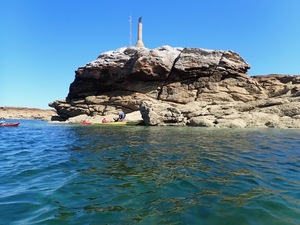
There is a red and white beacon (although rather faded) and the aerials associated with an isolated weather station, which no longer functions. on the summit of the main rock. If conditions allow, later in the season, then a climb to the top of the rock gives superb views across the reef, giving an idea about the scale of the Minquiers. As both Cormorants and Common Terns have been know to breed on this rock it is important to avoid landing during the breeding season.
A remote camera located on this rock managed to capture the birth of a Grey Seal between 08.00 and 09.00 on the 16th October 2019. This was the first confirmed breeding in Jersey waters although there may have been others, because young seal pups are washed ashore, around Jersey, most autumns.
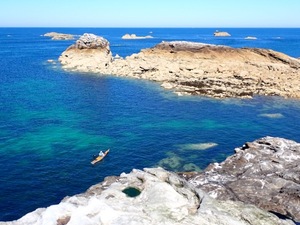
To the west lies Newfoundland, a bit excessive for a day trip so we returned to the east, the flooding tide allowing us to explore channels and areas of the reef, which had been closed to us on the paddle out.
The transformation of the landscape is quite astonishing. On large Spring tides, a 12 metre tide range, results in a huge exchange of water every 12 hours. A quick reference to the 12ths Rule indicates that in the the 3rd and 4th hours the water level changes vertically, by 5cm every minute of those 2 hours. The water does literally run up the beach!
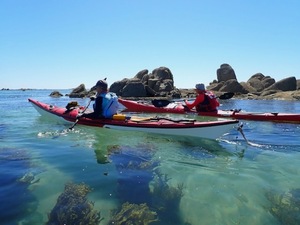
Arriving back on Maitresse Isle, the only other visitorss were preparing to leave, meaning that we had the reef to ourselves for the last night of our trip. Jersey, with its population of 110,000 inhabitants, could have been on the other side of the world. The following morning we headed north, after a wonderful night trying to identify the lighthouses and French towns, with Normandy to the east and Brittany to the south.
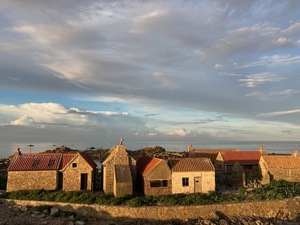
If we hadn’t been restricted in our movements in the summer of 2020 we would have been kayaking in Greenland, at the time we were visiting the Minquiers. This was definitely not a second best. It was an amazing experience to stand on such an isolated rock, less than 15 miles from my house, and to be possibly the first people to stand there since 2019. This really was a local adventure.
Kevin Mansell